
One passport for every product, from the label to the last owner
xProduct builds the digital product passport behind the QR code: materials, carbon, care, repair, certificates and end of life, with access levels for professionals and authorities, and a record of every change. For the EU and UK, from one product to thousands.

- passport sections to choose from
- ≈65
- tabs, or one page, per passport
- 4
- reader levels: public, professional, authority
- 3
- separate hosting for each site's data
- UK · EU
93 days · to the first fixed passport date in the EU and Northern Ireland: batteries, 18 February 2027.
Which rules apply to my products?01/The basics
What is a Digital Product Passport (DPP)?
A digital record of one product: what it is made of, where it comes from, how to use, repair and recycle it, and which documents back it up. A code on the product leads to it. The EU's Ecodesign Regulation (ESPR, (EU) 2024/1781) sets the general rules; each product group's own act says when a passport becomes compulsory and what goes in it.
- 01
A unique product identifier
Each passport links to a lasting identifier that follows ISO/IEC 15459 or an equivalent; GS1 is one of the issuing agencies. The product act sets the level: one passport per model, per batch or per item.
- 02
A data carrier on the product
A QR code or similar on the product, its packaging or its documents, as the product act specifies.
- 03
Free to open, with access levels
Customers, businesses and authorities open it free of charge. Parts can be restricted to professionals or authorities, as each act sets.
- 04
Open and machine-readable
The data must be interoperable and stay available for the period the act sets, with a backup copy held by an independent passport service provider.
- 05
Registered in the EU DPP Registry
Implementing Regulation (EU) 2026/1778 sets up the Registry: an index of identifiers, not a store of passport content. It covers ESPR products, batteries, construction products, toys and detergents.
- 06
Eight published European standards
EN 18216, 18219 to 18223, 18239 and 18246 cover data exchange, identifiers, data carriers, storage, APIs, interoperability, access rights and integrity. They are voluntary, and we have not seen them cited as harmonised standards yet.
02/Why now
The passport dates, fixed and expected
No ESPR product-group act has been adopted yet, so no ESPR passport is compulsory today. Batteries and toys already have fixed dates in their own laws. Dates marked as estimates are not set in law.
- 18 Jul 2024
ESPR (EU) 2024/1781 in force: the general rules for product passports. A passport becomes compulsory only when a product-group act says so.
Fixed in law - 17 Jul 2026
Implementing Regulation (EU) 2026/1778 on the EU DPP Registry published. Reports say the Registry opened on 20 July 2026. The Registry helpdesk says its semantic checks and API specifications follow in releases before 18 February 2027.
Official status - 19 Jul 2026
Large companies may no longer destroy unsold clothing and footwear (medium-sized companies from 2030).
Fixed in law - 27 Sep 2026
EmpCo Directive (EU) 2024/825 applies: generic green claims such as "eco" are banned unless recognised excellent environmental performance can be shown, "carbon neutral" product claims based on offsetting are banned, and sustainability labels must rest on a certification scheme or be set up by a public authority.
Fixed in law - 18 Feb 2027
Battery passport (Regulation (EU) 2023/1542): electric vehicle, light means of transport and industrial batteries above 2 kWh. EU countries also name their Registry administrator by this date.
Fixed in law - 2026 – 2027
First ESPR product acts expected: iron and steel, then textiles and apparel, tyres and aluminium (EU working plan, indicative). Obligations usually start about 18 months after an act, so 2028 or later.
Estimate - 2028 or later
Construction products passport, once its delegated act is adopted (mid-2028 at the earliest). The working plan lists furniture for 2028 and mattresses for 2029 (indicative years for the acts; passports would follow later).
Estimate - 23 Sep 2029
Detergents passport under Regulation (EU) 2026/405, date as reported, still to be confirmed against the official text.
Estimate - 1 Aug 2030
Toy passport (Toy Safety Regulation (EU) 2025/2509): toys placed on the EU or Northern Ireland market need one, with the code on the toy.
Fixed in law - United Kingdom
No passport law in Great Britain yet: the Product Regulation and Metrology Act 2025 gives powers only, and the call for evidence on digital product records closed on 21 September 2026 with no response yet. Under the Windsor Framework, the EU battery and toy passport rules also apply in Northern Ireland.
Official status
A summary of the rules as of November 2026, not legal advice. Dates marked as estimates are not set in law. Product rules library
03/How it works
From product to passport in five steps
The same path for a shirt, a chair or a battery. Save a draft at any point and publish when the passport is ready.
- 01
Create the product
Four short steps: basics and picture, identifiers (SKU, model, GTIN, ECLASS suggested from the category), passport sections, then review. A phone preview shows the top of the passport as you type. Or import from CSV, Shopify or GS1.
4 stepsCSVShopifyGS1 - 02
Fill in the sections
Each category recommends its sections, or let Dipo, our AI helper, suggest a set. Example values stay hidden until you confirm them, so nothing made-up goes live.
RecommendedDipo AI - 03
Publish
The public passport goes live, free to open with no sign-up. It refreshes when you save; restricted parts stay with the readers you allow.
PublicRestricted - 04
Put the code on the product
Download the QR label with its minimum print size, write the same link to an NFC tag, or use a GS1 Digital Link address. One code per model, or one per item with serial numbers.
QRNFCGS1 Digital Link - 05
Keep it up to date
Every change goes to the product's ledger. Repairs, returns, transfers and recycling are added over the product's life, and the passport as it was on any date stays readable.
LedgerVersionsLifecycle -
Try it
Build your first passport on the free plan
No card needed. Add one product and see the passport your customers will see.
04/Passport sections
What's inside a passport?
About 65 ready-made sections, each with its own fields. The category recommends a set; add, remove and reorder them per tab. Your plan sets how many sections a product can have.
Materials
- Material composition
- Material sourcing
- Material risk analysis
- Critical materials
- Recycled content
- Recycled material sources
Carbon and energy
- Carbon footprint
- Embodied carbon
- Emissions comparison
- Energy efficiency
- Energy label
- Energy trend
- Energy use
Environment
- Environmental impact
- Savings
- Resilience
- Environmental compliance
- VOC emissions
- Sustainability score
- Benchmarks
Supply chain
- Supply chain transparency
- Supply chain timeline
- Factory map
Repair and durability
- Repairability score
- Tools needed
- Disassembly
- Spare parts
- Durability and lifespan
- Software support
- Warranty
Care
- Care instructions
- Care label symbols
- Product care
- Storage and longevity
End of life
- Recyclability
- Compostability
- Disposal impact
- Take-back
- Returns
- Recycling centres
- Upcycling
- Packaging
Compliance
- Certifications
- Certification benefits
- Regulatory compliance
- Testing and verification
Batteries
- Battery label
- Performance
- Durability
- Restricted battery data
Food
- Ingredients
- Nutrition values
- EU nutrition table
- Front-of-pack
- Nutri-Score
Toy safety and companies
New- Age and warnings
- CE / UKCA
- Standards
- Safety Gate link
- Responsible companies
Your own
- Key specifications
- Custom content
- Custom templates (Enterprise and above)
05/The public passport
What a customer sees after scanning
A fast, readable page on any phone, in the languages you publish, with a language switch on the passport. No app and no sign-up.
- Four tabs or one page — Overview, Sustainability, Care & Repair and Compliance, or everything on one page with no tabs, chosen per product.
- Passport score — 70 points for completeness against the sections the category expects, 30 for evidence: a GS1-checked barcode, a current certificate, an anchored certificate and a compliance document. It rates the passport, not the product, and you can hide it.
- Language versions — Each language is its own passport, reached from the same code through the language switch. You write the translation; the sections are copied for you.
- Who is responsible — A strip naming the manufacturer, importer or seller, and for toys the age, warnings and a link to the EU Safety Gate recall site above the tabs.
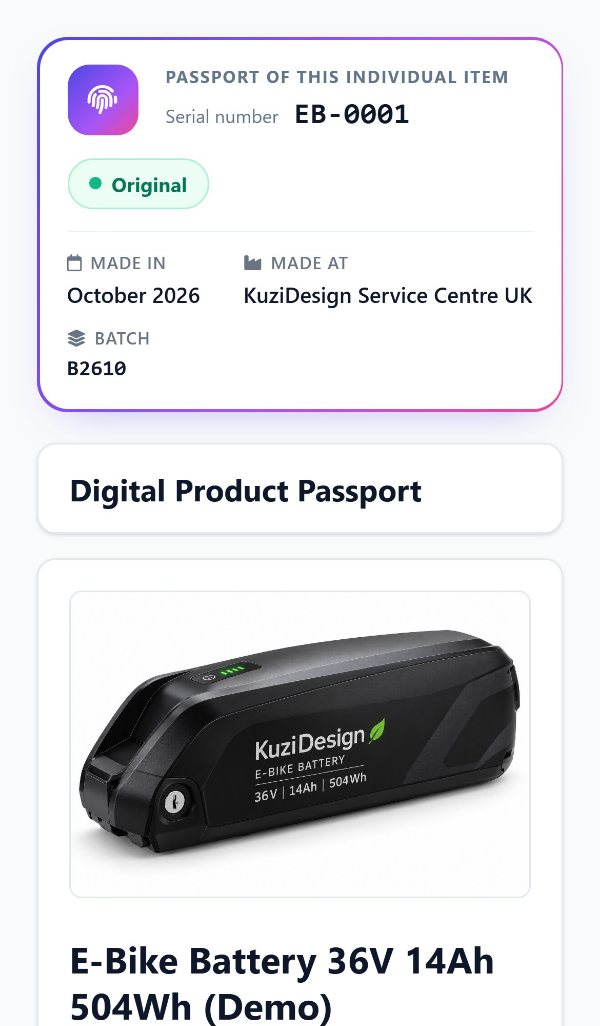
- This exact item — Scan an item's own code and a card shows its serial number, batch, where and when it was made, and its status.
- Readers' privacy — We do not store readers' IP addresses or visitor ids with passport views, and there are no third-party analytics or marketing scripts: only an anonymous scan count (country, kind of device, time on page) for the brand. A printable version is there, and on paid plans a warranty "Activate" link.
06/Access levels
Who sees what
Mark any section as public, professional or authority. Public readers see a short notice where restricted data sits; the rest is shown only to readers you let in.
| Data | Public | Professional | Authority |
|---|---|---|---|
| Public sections: product, materials, care, repair, end of life | Yes | Yes | Yes |
| Restricted sections, such as disassembly or test details | Notice only | Yes | Yes |
| Restricted files, as links that expire after 30 minutes | No | Yes | Yes |
| Battery health readings per item | No | Yes | Yes |
| How access is given | Open to all | Partner link | On request, signed links |
Access log (following EN 18239) — every opening of restricted data is written to an append-only, hash-chained log that you can read on the Access log page.
07/Identifiers and data carriers
One code, the right passport, at every level
Model, variant, batch or single item: each can have its own passport address, and every code handed out is recorded.


- GTIN and GLN
- GTIN-8/12/13/14 · GLN
- Barcode numbers are checked against GS1; your company's GLN sits on the account.
- GS1 Digital Link
- /01/{gtin} · /21/{serial} · /10/{lot}
- A built-in resolver turns GS1 web addresses into the right passport: the model, one serial number or one lot.
- QR codes
- SVG · PNG
- Print-ready labels with the smallest size that still scans, and sheets of 240 labels for single items.
- NFC tags
- NDEF · EN 18220
- The tag holds the same link as the QR code, so both open the same passport.
- Variants
- colour · size · pack
- Each version of a product gets its own passport and code.
- Units and serial numbers
- Original · Reused · Repurposed · Remanufactured · Waste
- One passport per item with its status; an item that continues as a new product is linked to its new passport. Battery health readings show only to professional and authority readers.
- Batches
- factory · steps · templates
- Production batches with their factory and steps, on the Manufacturer plan.
08/Tamper-evident
Every change recorded. Any change can be checked.
Every change to a passport, its values, its documents and its publishing, goes to the product's ledger, each entry linked to the one before. Each night, after checking every chain, xProduct writes one fingerprint per account to the Polygon public blockchain whenever something has changed since the last record.
Tamper-evident means a later change can be seen and checked. It does not make the data correct: what a passport says remains the company's own statement.
- Linked ledger entries — each change is a SHA-256 entry chained to the one before; "Verify integrity" re-checks the chain and a PDF report records the result.
- A public record each night — one fingerprint per account, written only when something changed, so anyone with the integrity report can compare it with the blockchain.
- Certificates, one by one — anchor a single certificate on request: a fingerprint of its details and of its file goes on the blockchain. The certificate itself is not published there.
- The passport on any date — every version is kept for the passport's lifetime, for public, professional and authority readers, a minute after each save and every night. Older versions follow the same access rules as the current passport.
- A signed passport (following EN 18246) — passport data comes with an ES256 signature; the public keys are published, so anyone can check it. It is xProduct's seal on the company's behalf, not the company's own certificate.
09/Data out
Your data, readable by machines and never locked in
Passports can be read through an open API, exported in standard formats and taken with you as a full archive.
Read API
Read a passport, one element of it, or several products at once, following the EN 18222 read routes. Battery readings can be sent in.
Standard export
The passport in the EN 18223 interoperability format, plain or signed, with names and descriptions per language.
Data dictionary
About 200 fields, each with its meaning and unit, as JSON and as a readable page.
Registry file
A JSON or XML file for battery passports, up to 100 per file, ready for the EU DPP Registry.
Full archive
One ZIP with products, sections, certificates, packaging, spare parts, battery and toy data, items and ledger events.
Nightly copy
Every public passport is copied each night to a separate host, so printed codes can keep working if our service stops. This is our own copy, not the backup by an independent passport service provider that product acts may require.
Not yet: creating or changing passports through the API, and registering them in the EU Registry directly. The Registry's own checks and API specifications are due in its releases before 18 February 2027.
10/Rules and claims
Know which rules apply, and what is still missing
Tools that point to the rules for your products and the data each one needs. They help you prepare; they do not replace legal advice.
Regulation Navigator
Answer a few questions in about two minutes and see which product rules are likely to apply, with their dates.
Open Regulation NavigatorProduct rules library
One page per rule: what it asks for, who it applies to and when.
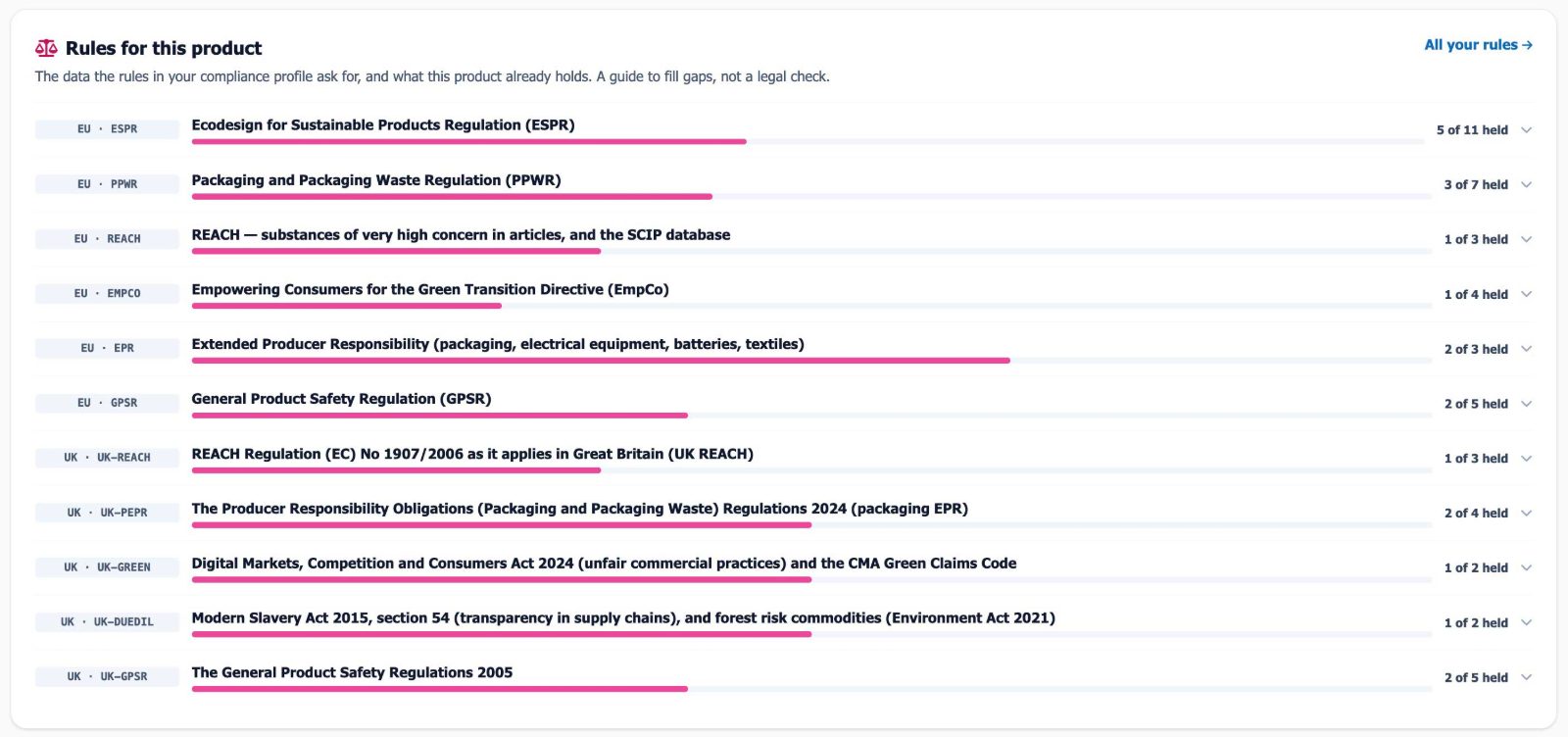
Open Product rules libraryRules for this product
On each product: the rules that may apply, the data each one needs, what you already hold, and a link to fill in the rest. Never shown on the public passport.
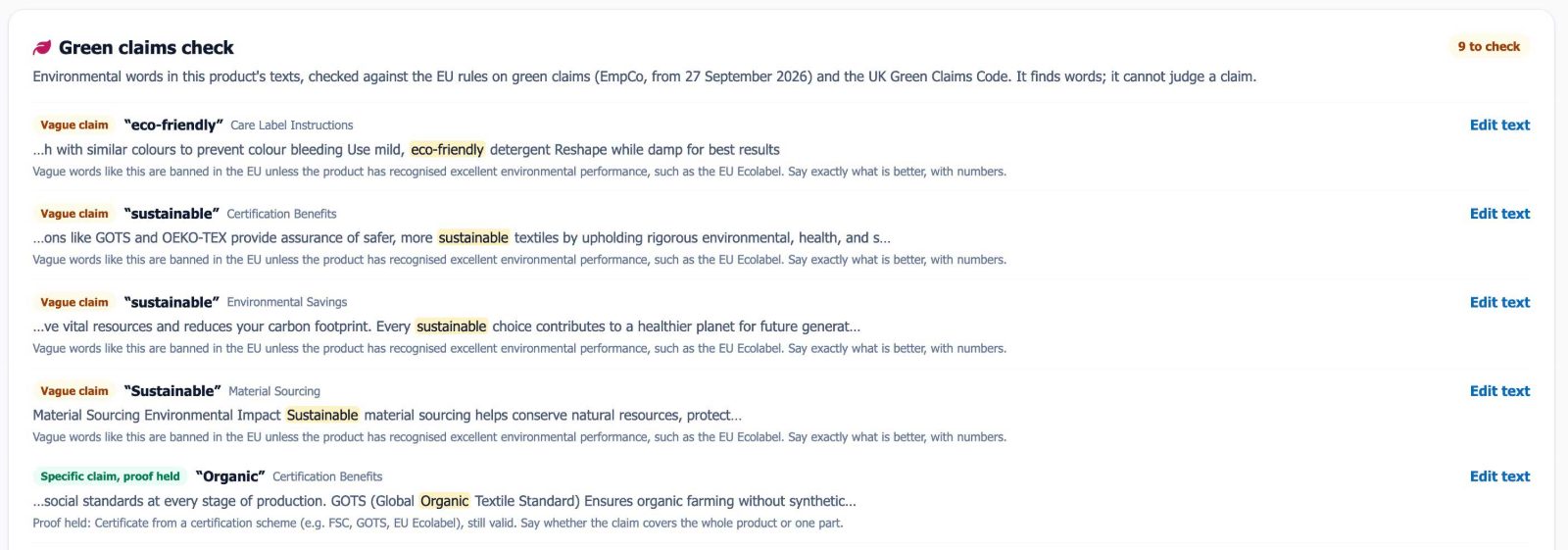
Green claims check
Flags wording such as "eco-friendly" or "carbon neutral" that the EU's EmpCo rules (from 27 September 2026) and UK rules restrict, so you can back it up or change it.
Certificate library
Keep your certificates in one library, with reminders before each one runs out. On paid plans, upload a certificate and AI fills in its details for you to check.
Carbon calculator
A quick estimate of your company's footprint from electricity, gas, vehicles and flights. It is not a product life-cycle assessment; product figures go in the Carbon footprint section.
Open Carbon calculator11/Inside the product page
Know what each rule asks for
Two checks on the product page show which data your rules ask for and which words in your texts need care. They are a guide to help you prepare, not legal advice.
Tap to open full size
Tap to open full size
Screens from a demo account. Manufacturer and Enterprise plans.
12/After the sale
A passport that follows the product's life
Repairs, returns, new owners and recycling are added as events. Events are never edited or deleted, only added.
- 01Product created
- 02Batch made
- 03Certificate anchored
- 04Sold or transferred
- 05Repaired or returned
- 06Recycled
- 07Passport finalised
Partner workspace
Repair, return and recycling partners log their work, such as recycled weights and recovery rates, through a link or their own sign-in. You approve before it reaches the passport.
Transfers of ownership
Hand a product or batch to a new owner, such as an importer. The transfer is recorded in the ledger.
Warranty registration
Warranty policies on every plan. On paid plans, buyers activate their warranty from the passport with a receipt, one registration per item, in the passport's language.
Roles for your team
Team members and roles on Teams and above; read-only auditors and lifecycle managers on the Manufacturer plan.
13/Shopify
Passports inside your Shopify store
Our two approved Shopify apps, one for UK stores and one for EU stores, build passports from your Shopify products: choose the products, and the pictures are copied to our storage. Theme blocks and a widget show the passport on your product pages.
- Free£010 passports
- Starter£9.99100 passports
- Growth£24.99500 passports
- Pro£49.991,000 passports
Shopify plans are billed through Shopify.
Integrations14/Where your data lives
UK data in the UK, EU data in the EU
Accounts on the UK site keep their data in the United Kingdom.
Accounts on the EU site have their own database and file storage in the EU.
Public passport pages are also copied each night to a separate host, and only fingerprints, never passport data, go on the public blockchain.
- Site languages — English, Deutsch, Slovenčina, Français, Polski, Čeština, Español
- Two-factor sign-in — an extra code when you sign in, once you turn it on.
15/Plans
Which plan has what
Start free with one product. Every paid plan adds QR codes; bigger plans add more products, sections and tools.
Free
0 €- products
- 1
- sections
- 3
- items
- 10
Try the passport with one product. No QR code.
Starter
9.99 €- products
- 10
- sections
- 6
- items
- 100
Adds a QR code for every product. 84 € a year if paid yearly.
Teams
19.99 €- products
- 100
- sections
- 12
- items
- 500
Adds scan counts and discounted printed labels and tags.
Enterprise
39.99 €- products
- 500
- sections
- 16
- items
- 2,000
Adds your own templates, Rules for this product and the green claims check.
Agent
99 €- products
- ∞
- sections
- 16
- items
- 2,000
For consultants and agencies managing several client accounts from one dashboard.
Manufacturer
150 €- products
- 1,000
- sections
- 16
- items
- 10,000
Adds batches, production steps, partners and portals, auditors, lifecycle roles and the integrated carbon calculator in the Manufacturer workspace. 7-day trial.
Prices per month. "Sections" is the number per product; "items" is the number of serial-numbered items. Current prices and limits are on the pricing page.
View pricing16/Live examples
Open a real passport
Four published passports from our demo company, as anyone sees them after scanning.


17/FAQs
Short answers
Another question? We are happy to answer it, or to show you the app in a short demo.
Do I need a passport today?
Not yet. No passport is compulsory today. The first fixed date is 18 February 2027, for electric vehicle, light means of transport and industrial batteries placed on the EU or Northern Ireland market. Toys follow on 1 August 2030. Other ESPR product groups wait for their own acts. Great Britain has no passport law yet. The Regulation Navigator shows what is likely to apply to you.
Can I control what information is public?
Yes. Each section can be public, for professionals or for authorities. Public readers see a short notice where restricted data sits.
Do passports update when I change product information?
Yes. The public passport refreshes when you save, and the code on the product stays the same. Earlier versions stay readable by date, and every change is recorded in the ledger.
What happens to earlier versions if I withdraw a passport?
Every version is kept for the passport's lifetime, and older versions follow the same access rules as the current passport. When a passport is withdrawn, the public sees it as no longer available, while authorities with an approved access link, partners with access and the manufacturer's own team can still read its versions by date. Products already sold should keep their passport available for the period the product rules set, so updating a passport is usually better than withdrawing it.
Which industries does xProduct support?
Any product with a category in xProduct, including clothing and footwear, batteries, furniture, electronics, home appliances, toys, food and construction products. Each category recommends its own passport sections.
Does publishing a passport make my product compliant?
No tool can promise that. xProduct holds and publishes the data you enter and, for the rules it knows, shows what may be missing. What the passport says is your own statement, and the rules for your product decide what it must contain.
Do I need GS1 barcodes?
No. Every passport has its own web address, and on paid plans its own QR code; the rules ask for a unique identifier, not a GS1 one. If you have GTINs, xProduct checks them and can answer GS1 Digital Link addresses.
What happens to my passports if xProduct stops?
Every public passport is copied each night to a separate host, so printed codes are designed to keep working, and you can export everything as a ZIP archive at any time.
Ready to publish your first Digital Product Passport?
Start with one product on the free plan, or book a demo and see a passport built step by step.
A summary of the rules as of November 2026, not legal advice. Dates marked as estimates are not set in law.